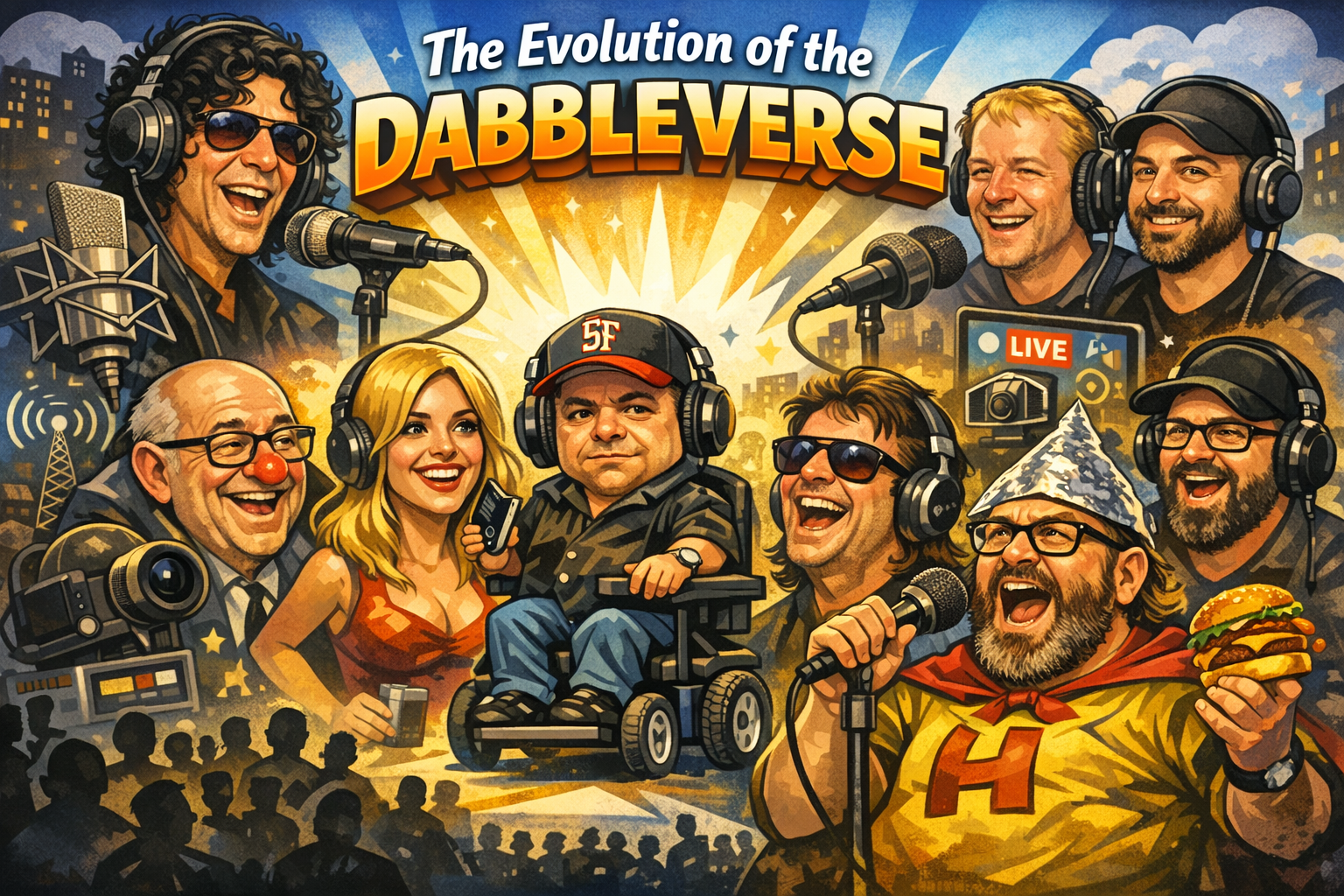
The Dabbleverse is, at its core, an unusually interactive community of long‑time Howard Stern and Opie & Anthony fans. Its rhythms, its humor, and its cast of recurring personalities all descend from a very specific lineage of American shock‑radio culture. To understand why the Dabbleverse behaves the way it does, you have to understand where its audience learned these behaviors in the first place.
Long before the internet coined the term LOLcow, the Stern Show had already built a functioning ecosystem of them. Aside from the medieval court jester and the village idiot, the earliest modern prototypes were the Wackpackers—a rotating cast of eccentric, unpredictable, and often unintentionally hilarious characters who became central to the show’s identity. They weren’t guests. They weren’t callers. They were characters, and the audience learned to treat them as such.
The Wack Pack as the First Modern LOLcow System
The Wack Pack established the template that the Dabbleverse still follows today:
- exaggerated personalities that generated content simply by existing
- predictable behavioral loops that fans could anticipate and track
- a feedback system where attention amplified the behavior
- a participatory audience that shaped the narrative as much as the hosts
- a shared universe with lore, rivalries, alliances, and arcs
This wasn’t passive entertainment. It was a folk culture, built collaboratively between the show and its listeners. The audience learned to analyze, categorize, and narrate these personalities with the same seriousness one might apply to sports or politics.
That instinct never went away.
O&A and the Internet‑Native Evolution
When Opie & Anthony arrived, they inherited Stern’s character‑driven model but extended it into the early internet era. Their listeners were among the first to weaponize:
- message boards
- clip culture
- remixing
- live trolling
- community‑driven lore
The O&A audience didn’t just consume content—they co‑authored it. They created the conditions for what would later become the Dabbleverse: a decentralized, always‑on, self‑aware ecosystem where the line between performer and participant is intentionally blurred.
The Dabbleverse as the Third Generation
The Dabbleverse is the natural third stage of this lineage:
Wack Pack → O&A Forums → Dabbleverse
It combines:
- Stern’s character archetypes
- O&A’s participatory chaos
- modern streaming tools
- parasocial feedback loops
- a community trained for decades to treat eccentric personalities as shared property
The result is a digital folk culture with its own rules, rituals, and recurring cast—a world where the audience is both archivist and provocateur.
Shuli Egar and Karl Hamburger: The Institutional Memory of the DV
Few figures embody this lineage more clearly than Shuli Egar, owner of The Shuli Network and co‑host of The Uncle Rico Show. As the original Wackpack Wrangler, Shuli spent years embedded inside the Stern ecosystem, learning how to manage volatile personalities, document their behavior, and translate chaos into narrative. He developed an instinctive understanding of character arcs, audience dynamics, and the anthropology of fringe personalities. That skillset transfers seamlessly into the Dabbleverse. Shuli isn’t just a commentator—he’s one of the only people who has lived through every evolutionary stage of this culture.
Alongside him is Karl Hamburger of Who Are These Podcasts, whose structured, clip‑driven analysis provides the Dabbleverse with its critical framework. Karl represents the other half of the cultural lineage: if Shuli is the Stern‑era anthropologist, then WATP is the modern heir to Opie & Anthony’s Jocktober—the annual ritual where radio shows were dissected, mocked, and deconstructed with forensic precision. Jocktober taught an entire generation of fans how to break down audio, expose patterns, and treat broadcast personalities as case studies. Karl has revived that format for the podcast era, applying the same methodical teardown style to modern creators.
Together, Shuli and Karl form the closest thing the Dabbleverse has to a news desk—one rooted in decades of radio, comedy, and fan‑driven media literacy. Their combined presence gives the ecosystem both its historical memory and its analytical backbone, linking the Wack Pack to Jocktober and carrying both traditions into a new, always‑on digital universe.
The Dabbleverse as Living Folklore
The Dabbleverse is not just a fandom. It is a living, evolving folk culture built on:
- shared memory
- recurring characters
- communal storytelling
- ritualized mockery
- participatory observation
It is the modern descendant of the Wack Pack—a digital village square where the “idiots” and “jesters” are not marginalized but central to the narrative.
And like any folk culture, it benefits from documentation. Not mockery. Not outrage. Documentation.
That’s where the authoritative‑anthropologist voice fits. It doesn’t elevate the subject—it elevates the storytelling.
A Tip of the Hat to the Prototype
There is one figure whose absence is felt in every corner of the Dabbleverse, not because he was ever part of it, but because he unintentionally wrote the blueprint for what it would become. If Eric the Midget were still with us, he would be the undisputed King of the Dabbleverse. Long before livestreaming was a cultural norm, Eric was already broadcasting on JFSC, creating one of the earliest examples of a fan‑driven, interactive micro‑ecosystem built around a single volatile personality. His streams had all the elements the DV now thrives on: real‑time meltdowns, audience participation, lore building, and a performer who was both deeply self‑serious and unintentionally hilarious.
Eric wasn’t just a Wackpacker; he was the first modern streamer‑LOLcow hybrid, a prototype for the digital characters who dominate today’s creator‑driven universes. His presence would have fit the Dabbleverse so naturally that it’s impossible not to imagine him anchoring its chaos, feuding with half the roster, and generating nightly content for every commentary channel in the ecosystem.
In a culture built on lineage, Eric stands as the missing monarch—proof that the Dabbleverse didn’t appear out of nowhere but evolved from decades of audience‑shaped character worlds.